Showing posts with label Mystagogy. Show all posts

Saturday, May 26, 2007

Wickedness and grace

Sometimes a sense of futility creeps upon us. We despair that “they don’t come back for mystagogy.” Or we fret that “we can’t find enough sponsors.” We bemoan the lack of participation among the members of the assembly. And now the diocese wants us to run the catechumenate “year round” when we are already stretched too thin.

How do we even begin to think about solving these and similar problems? If you are like me, you fantasize that there is “an answer” out there. Some parish or some person smarter or more experienced than I am must have solved all this already. But down deep, we know that really is a fantasy, don’t we?

Wicked problems


10 characteristics of wicked problems

1. There is no definitive formulation of a wicked problem
2. Wicked problems have no stopping rule
3. Solutions to wicked problems are not true-or-false, but good-or-bad
4. There is no immediate and no ultimate test of a solution to a wicked problem
5. Every solution to a wicked problem is a "one-shot operation"; because there is no opportunity to learn by trial-and-error, every attempt counts significantly
6. Wicked problems do not have an enumerable (or an exhaustively describable) set of potential solutions, nor is there a well-described set of permissible operations that may be incorporated into the plan
7. Every wicked problem is essentially unique
8. Every wicked problem can be considered to be a symptom of another problem
9. The existence of a discrepancy representing a wicked problem can be explained in numerous ways. The choice of explanation determines the nature of the problem's resolution
10. The planner has no right to be wrong (Planners are liable for the consequences of the actions they generate)

These kinds of problems are what Horst Rittle, a pioneering theorist of design and planning, and late professor at the University of California, Berkeley, called "wicked problems." Rittle figured out that many problems cannot be solved by “experts” dropping in and delivering a ten-point plan, even if they have experience in your specific area of difficulty. This is, in fact, the very type of solution most of us go looking for. We go to a workshop or buy a book or hire a speaker to just tell us what to do. The thing that makes your problem “wicked” is there is no one solution. And each potential solution raises other problems. And, this is really key, each problem is unique. The reason your neophytes don’t come back for mystagogy is essentially different than the reason other neophytes in other parishes don’t come back. In fact, the reasons among your own neophytes are all unique as well.

Jim Conklin, author of Dialogue Mapping: Creating Shared Understanding of Wicked Problems, went on to develop Rittle’s ideas further. Conklin says wicked problems have these characteristics:

  1. The problem is not understood until after formulation of a solution.
  2. Stakeholders have radically different world views and different frames for understanding the problem.
  3. Constraints and resources to solve the problem change over time.
  4. The problem is never solved.

Don’t you just hate that last one?

There is no "solution"

But think about it for a minute. Isn’t the lack of a “solution” the very thing that makes the conversion process an encounter with grace? The catechumenate is not a puzzle. There is no final answer. It is a mystery—a mystery of love. How do we solve that mystery? We can’t. We can only enter into it.

Conklin says:

Because of social complexity, solving a wicked problem is fundamentally a social process. Having a few brilliant people or the latest project management technology is no longer sufficient.

We might paraphrase that to say that because of the radical, loving relationship of the Father and the Son (in which we are immersed through the power of the Holy Spirit), solving a wicked problem is fundamentally an ecclesial process. Having a few brilliant theologians or RCIA experts is insufficient.

The answer is the community

In other words, the initiation process, from start to finish

…is the responsibility of all the baptized. Therefore the community must always be fully prepared in the pursuit of its apostolic vocation to give help to those who are searching for Christ…. Hence, the entire community must help the candidates and the catechumens throughout the process of initiation. (RCIA 9)

This means that all the multiple, complex, disjointed, busy and distracted parts of the Body of Christ must share a commitment to entering into the messy process of conversion together (with each other and with the catechumens). And they must share a commitment to love and support one another in that process. This won’t “solve the problem.” But it will bring us all more fully into the love of Christ.


[This post was inspired by Jim McGee. See his post on Solving puzzles or framing mysteries for more information on wicked problems.]

Wednesday, May 9, 2007

Awe Inspiring Rites?

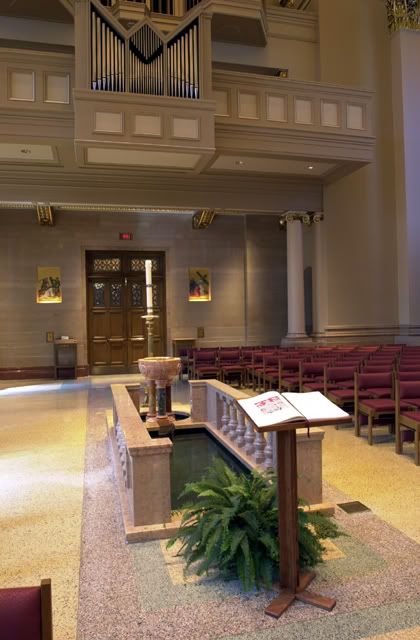
I recently conducted a catechetical session for a parish that is planning to build a new baptismal font. To begin, I asked those who came—a rather large group of about ninety adults and teenagers—to recall a memorable experience of baptism they either took part in or witnessed. Everybody had one! They shared warm, enthusiastic memories with each other, and some of the stories were shared with the large group too. This was clearly a group of people who loved their parish and had a high regard for the sacraments and for the church.

Their response to the next exercise, however, was telling. I asked for a show of hands in answer to the following questions: What stood out in their memory? The people? The action? The words? The emotions? The water? Hands went up for each and every item—except the water. The water did not stand out for anybody in that room, among all the good memories they cherished.

Clearly, they needed a new font.

But their response to the exercise got me thinking. Where are our powerful memories of baptismal water—that primary “sign” of the foundational sacrament of the whole Christian life? If our sacramental system is going to survive in this century as a living organism and not just a museum piece, there has to be a core of real-life experience at the center of it. Are we etching the sacraments in the deep places of the soul, in today’s church?

Water has been for me the centerpiece of a whole liturgical experience that qualifies as “awe-inspiring” or “spine-tingling” as Edward Yarnold, SJ, once called it. I can still see the light shimmering on the water of the glorious font at St. Paul the Apostle church in New York as we gathered around it for Easter Vigil baptisms. The completely drenched appearance of the newly-baptized at St. John Cathedral in Milwaukee comes to my mind; I can see them dripping, smiling, triumphant. I remember the astonishing depths of the water in which my husband-to-be was baptized at St. Ignatius Loyola church in New York—he was immersed in the water three times, each time diving in deeper than the last, until finally the pastor and sponsor thought they’d lost him! These are powerful memories. For me, the stories of creation and crossing the Red sea found a touchstone in the waters of these fonts—waters that were breathtakingly beautiful, dangerous, and a place where miracles happen.

You don’t get the same effect standing around a punch bowl. Yet I’m afraid that something the size of a punchbowl, or even smaller, is what most Catholics call the font.

What do you remember of baptism at this year’s Easter Vigil?

Wednesday, April 11, 2007

Five Ways to Preach Mystagogically

These approaches to preaching mystagogically are defined by Jan Michael Joncas in Forum Essay, Number 4: Preaching the Rites of Christian Initiation (Chicago, Illinois: Liturgy Training Publications, 1994) 95-117.

The five approaches outlined by Joncas are:

  1. hallowing cosmic symbols;
  2. exploring anthropological patterns;
  3. celebrating biblical history;
  4. analyzing beliefs and behaviors; and
  5. revealing the future present.

According to Joncas, these are general techniques used by the majority of mystagogical preachers from the 2nd to the 5th centuries of the church. These preachers looked to the phenomenology of the heavens and nature to find correlations with the symbols of the rites. They were keen observers of human ways of life, social structures, and secular activities. They wove images and references to various scriptural passages that evoked the same symbols, whether or not the context of the passage related to the context of the rite. Their catecheses and homilies were often pointed critiques of beliefs and behaviors that went against their understanding of the Christian lifestyle. Finally, they employed a realized eschatology in the use of their images, placing the event of the rite within the vision of the eschaton so as to lead the hearers to praise of God and conversion of heart.

Joncas cautions that the use of these approaches to craft initiatory homilies for today must take into consideration that the world of the 4th century is much different from ours. Advances in our understanding of society, cosmology, scripture, medicine, and even demonology would make a direct translation of these approaches inappropriate for contemporary hearers. Nonetheless, if interpreted and translated into a contemporary style, these approaches can give preachers today some guidelines for crafting mystagogical texts in the patristic tradition.

Five Principles for Mystagogical Preaching and Catechesis

Image courtesy of imageafter.comIn the Rite of Christian Initiation of Adults, only two pages of texts are given to describe the period of mystagogy and post-baptismal catechesis. Below are the five main things you need to know about mystagogy during this period of the initiation process (from RCIA 244-247):

  • Mystagogy and mystagogical preaching leads the neophytes and the community to a deepened grasp of the paschal mystery and helps them make it part of their lives through


    • meditation on the Gospel

    • sharing in eucharist, and

    • doing works of charity.

  • Mystagogy and mystagogical preaching introduces the neophytes into a fuller and more effective understanding of the mysteries through the Gospel and the sacraments.


  • The main setting for mystagogy is the Sunday Mass.


  • At Masses during the Easter season where neophytes are present, it is recommended to use the readings for Year A.


  • Mystagogy and mystagogical preaching renews the inspiration and outlook of the faithful and brings them closer to the neophytes.

Tuesday, April 10, 2007

What is Mystagogy?

Below is part of the unformatted text from a bulletin insert that you can download, print, and copy for FREE for use in your parishes to help you catechize about mystagogy. Please include the author and copyright information on any copies you make.

Get the fully-formatted ready-to-copy bulletin insert (pdf) here.Get the fully-formatted ready-to-copy bulletin insert (pdf) here.


Mystagogy: Savoring the Mystery of God

by Diana Macalintal
© 2007, Diana Macalintal.
All rights reserved.

Image from Imageafter.com. © 2003-2007 image*after and its licencees. Content is copyright-free.Whodunit? Secret? Science?

God is a mystery, but not like an Agatha Christie novel, or a secret reserved only for special people, or a math problem to be solved.

God is a mystery in the way that grandma’s love is a mystery; in the way you look at your child and can’t imagine anything more beautiful; in the way you marvel at how deeply you still love your spouse even after so many years of being together.

The mystery of God is something that makes us feel so immensely close to God and at the same time so in awe of the tremendous, incomprehensible wonder of God. There is no way to completely, fully express this feeling or describe it to another person. We can only say the same thing we tell children who ask us how they will know when they’re in love—“you’ll know it when it happens to you.”

The word “sacrament” comes from the same Greek root for the word “mystery.” Often, at the beginning of Mass, the priest will say, “to prepare ourselves to celebrate these sacred mysteries….” Every time we gather to celebrate the sacraments, we enter deeply into the mysterious love of God.

We experience this divine mystery most fully in the Eucharist—that intimate act of eating and drinking together with those named after the one we love the most: Christ.

Reflecting on the Mysteries

Those who have been preparing to be initiated into the Church and are then baptized, confirmed, and welcomed to the Eucharistic table at the Easter Vigil are the newest members to be “christened,” that is, named “Christ.” They are those who have most recently and fully been hit by God’s mysterious love. Now, they know what it means to be a member of the Body of Christ because they have experienced it for themselves.

Anyone who is new to love and the overwhelming nature of it needs time to reflect on what happened to them. This “looking backward” to a specific moment when they experienced God’s mysterious presence gives them direction and renewed commitment for moving forward. Just like looking back at wedding pictures can give us more hope and joy for the future, reflecting on the experience of the “mysteries”—the sacraments—can renew our commitment to live according to Christ’s name which was given to us at baptism.

The neophytes are those who were recently initiated into the Church through the sacraments of baptism, confirmation, and Eucharist. During the Easter season, and often throughout the year after, they spend time reflecting on the mysteries. This process is called “mystagogy.” But their practice of mystagogy is simply a participation in what all baptized Christians are called to do. All of us who are baptized, whether last year or many years ago, are called to constantly reflect on our experience of God, discern its meaning, renew our commitment to our baptismal promises, and commit ourselves to living those promises in the ordinary events of our daily life.

Click here to read a step-by-step way to do mystagogy.

Mystagogy My Mother Could Do

Caring Mother, by losiek on Flickr, Attribution LicenseThe content of faith is the content of my mother’s or any mother’s life. That is because faith happens in and through our daily life. What we do on Sunday is simply one expression of our faith. We need to connect the messy un-“holy” events of daily life with God and all the things we call “holy.” But the most common mistake people make when trying to make sense of life and faith is they go into “Hallmark greeting card” mode. That is, when they talk about faith, they give religious platitudes like “God loves me,” or “Jesus answered my prayer.” Though these may be true, they won’t necessarily lead to conversion. In other words, it won’t change the world; but mystagogy will. This way of reflecting makes faith relevant to daily life, and makes daily life an expression of faith. But you don’t need a theology degree to be a “mystagogue.” Here are some simple steps to uncovering the mystery of faith that even my mother could do.

Step 1: Choose an event
Sharing faith starts with an event that engages us or makes us feel deep emotion. Family reunions, Easter dinner, graduation, a child’s birth, friend’s death, the shared experience of watching a movie or hearing a song—all these are ripe with moments in which the mystery of faith can be uncovered. During the event, pay close attention to all your senses (what you see, hear, touch, taste, smell) and to what you feel. Engage fully in the experience.

Step 2: Remember what happened
After the event, gather with others who experienced the same thing. Ask these questions: What did you see? What did you hear? What do you remember most? How did that make you feel? Be very concrete in your memories. For example, “I smelled bread baking when I came in the door, and that made me feel welcomed, like I belonged there.”

Step 3: Reflect on the bigger picture
What else is going on in your life that needs to be connected to this concrete experience and memory? What issues is your family dealing with? What concerns do you have at work? What are some major events happening in your community or in the world? For example, “That smell of bread baking makes me think of my own family and how I worry about making sure they have enough to eat. I worry about my job and if I’ll still have it next month. I think also of the man I see every morning on the street corner asking for money for food.”

Step 4: Connect with your faith
In this step ask what this memory teaches you about God, about Christ, about church, about community. For example, “My feeling of belonging when I smelled that bread baking teaches me that family can be anyone I share food with. It reminds me of all those Bible stories of Jesus eating meals with others and how we share bread and wine with strangers at Mass every Sunday. These strangers we call brothers and sisters because we eat together. It teaches me that no matter what, I can depend on my family, my community.” Find out what the Church and your parish teach about your insight. Connect it to a story in the Bible, and find out what scripture teaches about this.

Step 5: Make a change
This is the “so-what” step. What will you do differently in your life now that you’ve made these connections with your faith? Perhaps you might decide to participate in Communion with different eyes, really looking at each person in the Communion procession as your family. Maybe you’ll choose to begin each dinner with a simple prayer. You might get others in your family or parish to talk more about issues of homelessness and hunger. You can start a support group for those who have lost jobs or are looking for work.

When we reflect on our everyday life experiences in this way, our faith can and will change the world, one mother at a time.

This article by Diana Macalintal originally appeared in Eucharistic Ministries #233, August 2003.

Wednesday, April 4, 2007

How to do Mystagogy with the Neophytes in Easter

Cathedral of Our Lady of Peace in Honolulu from wikimedia, Public DomainFrank C. Senn writes about the mystagogical process for neophytes in the early church:

During the week after Easter Day, the neophytes attended the liturgy daily, wearing their white robes, while the bishops instructed them in the mysteries (sacraments) they had just experienced…. The faithful were also permitted to attend these sessions during the “week of white robes” and to ask questions of the bishop as he sat in his chair (cathedra) and expounded upon the mysteries of the faith. (The People’s Work: A Social History of the Liturgy, 70-71.)

Perhaps your bishop would never be able to clear his schedule for daily Mass at the cathedral during Easter Week. But are you sure? Have you asked him? And perhaps the neophytes would not attend in any significant numbers. But are you sure? Have you asked them?

If the bishop in his cathedra, surrounded by the still-damp neophytes, with the faithful also gathered, asking insightful questions is an ideal that just can’t happen in your diocese, how close could you come? Here are some possibilities. Click on comments to add your own ideas:

  1. In larger dioceses, ask one or more of the associate bishops to fill in.
  2. Ask the deans or monsignors of the diocese to each take a day of “cathedra” duty during Easter Week.
  3. Ask the bishop to write a mystagogical homily for each day of Easter Week that might be read or adapted by the homilists of the diocese.
  4. Record the bishop’s mystagogical homilies and upload as podcast on the diocesan Web site.
  5. Provide a place on the Web site for the faithful to ask questions of the bishop about his homilies.
  6. Focus smaller. Invite the neophytes of a given deanery or region to gather for weekday liturgy and mystagogical preaching.
  7. Focus still smaller. Ask your pastor to prepare a series of msytagogical homilies for Easter Week.
  8. For the neophytes who cannot be present for weekday liturgies, e-mail the homilies to them. “Require” them to respond with at least three questions.
  9. In any of the options above, invite the faithful to ask their questions as part of the homily.
  10. Publicize the mystagogical nature of this “week of white robes” throughout the diocese, deanery, or parish.
  11. Begin now to make it clear to the catechumens that they will be expected to be at the liturgies during the “week of white robes” after their own initiation.